

Research Library
What Is a Certificate of Analysis (COA)?
Learn how to read a COA, match your vial to its batch record, and follow the laboratory verification link for Source reports.
What is a Certificate of Analysis?
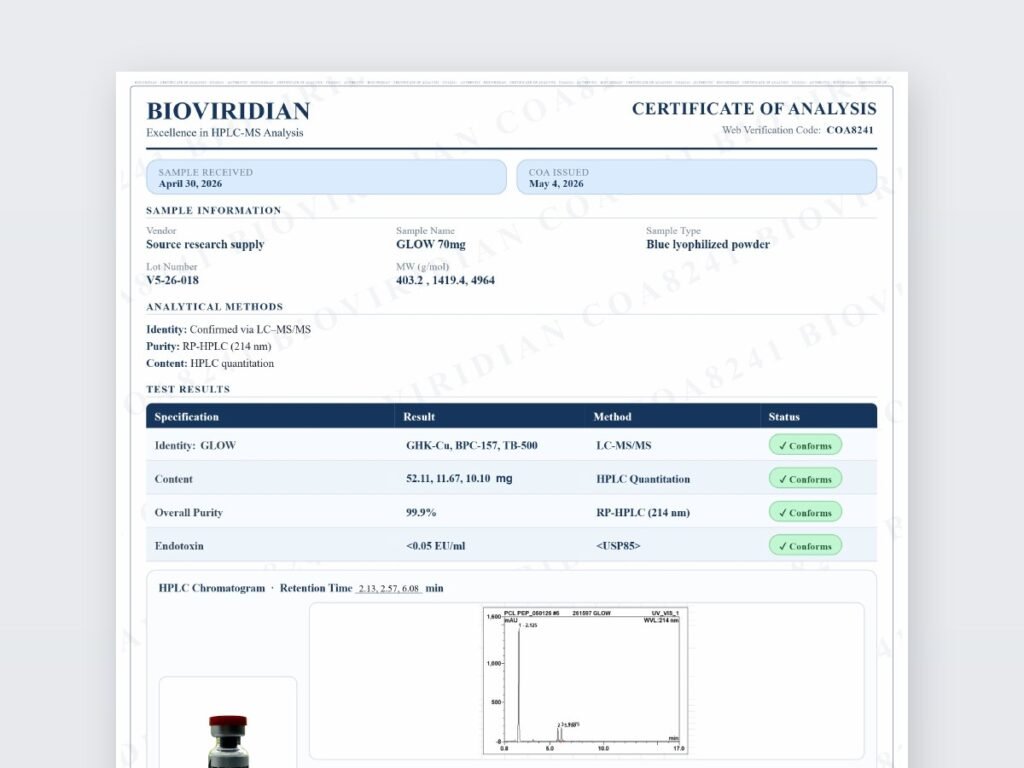
A Certificate of Analysis (COA) records analytical results for a specified sample or batch. Depending on the tests performed, it may report identity, chromatographic purity, measured content, endotoxins, appearance or other characteristics.
What information does a COA contain?
Fields and test panels vary between laboratories and reports. When reviewing a certificate, look for:
- Product or sample identity — the name assigned to the tested material.
- Batch or lot number — the identifier linking the report to the supplied batch.
- Report number and dates — the certificate reference and the dates stated by the laboratory.
- Methods and results — the tests performed, measured values, units and reported status.
- Sample details — information such as appearance or molecular weight, where reported.
- Laboratory details — the testing organization and any verification instructions.
Source’s current library displays Identity, Content, Purity and Endotoxin results from the available reports. “Conforms” is shown with a green check and a Passed status. This applies to the reported test and its specification; it does not establish that an unlisted test was performed. A certificate does not, by itself, establish laboratory accreditation.
Why is a COA important?
A COA provides a traceable record of the tests performed on a specified sample. Its value depends on the methods, sampling approach and the link between that sample and the supplied material. Match the batch number on your vial to the certificate rather than relying only on a product name or the newest report.
Third-party versus in-house COAs
Independent testing separates the commercial supplier from the laboratory reporting the result. Researchers should still review sample identification, methods and the scope of the certificate rather than relying on the document label alone.
How to read an HPLC chromatogram
A chromatogram plots detector signal against time. The target compound must be assigned using the analytical method; it should not simply be assumed to be the largest peak. Area purity compares the assigned target peak area with the integrated peak area included in the calculation. Detector response, overlapping peaks and integration rules affect the result.
HPLC area purity is distinct from net peptide content or the total material in a vial. Read our HPLC guide for the difference.
Verifying a Source COA
Open the Source COA Library, find the product and batch, then open the original PDF. The current Bioviridian reports include a report search code. Use the record’s “Verify on lab site” link to visit Bioviridian’s COA search and enter that code. Compare the laboratory record with the PDF, including sample name, batch, dates and results.
If a report cannot be found or details differ, contact Source for clarification. The library provides the report and verification route; it does not replace your laboratory’s review of the evidence.
Research use only. This article is for laboratory and scientific reference. Source products are supplied for in vitro laboratory research and are not for human or veterinary use, self-administration, diagnosis, treatment or prevention of disease.