

Research Library
Understanding Peptide Purity.
Understand HPLC area purity, how it differs from net peptide content, and why analytical methods and batch-specific COAs matter.
What is peptide purity?
HPLC purity describes the relative chromatographic signal assigned to the target compound under a specified analytical method. It is not the percentage of the vial’s total weight that is peptide. Related impurities can include truncated sequences, deletion peptides, oxidized variants and other compounds that the method separates and detects.
For example, a reported HPLC area purity of 98% means that the assigned target peak accounts for 98% of the integrated peak area used in that calculation. Water, counterions, salts and substances that are not detected by the method may not be represented. Net peptide content and measured vial content are separate measurements.
What is HPLC?
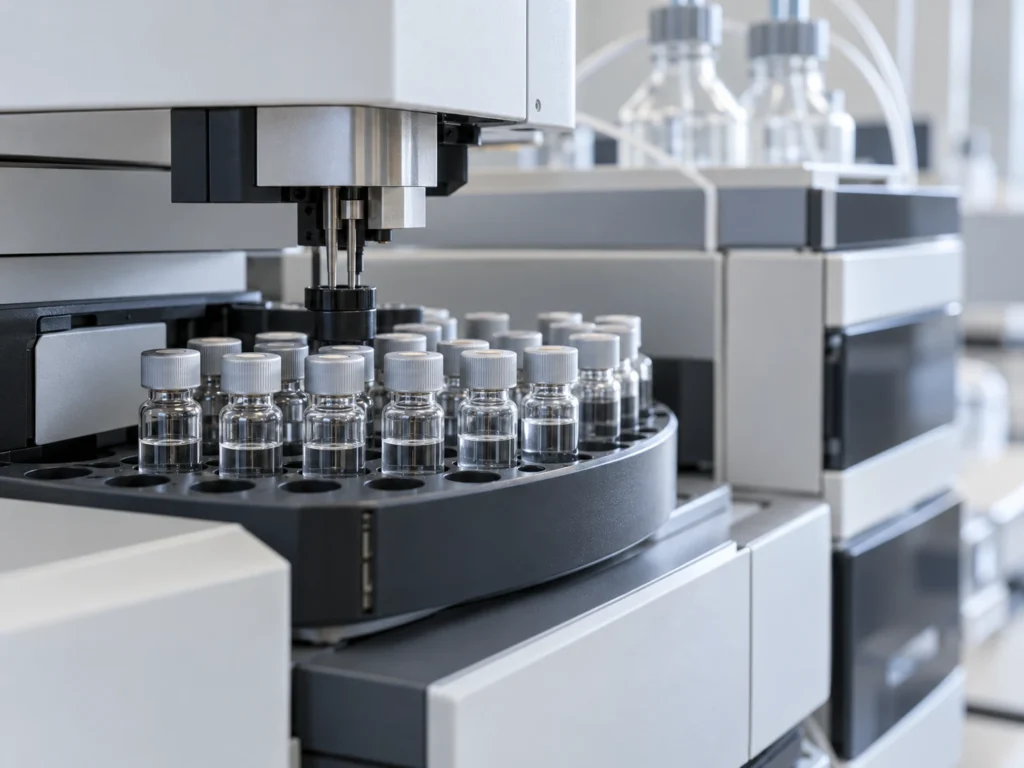
High-Performance Liquid Chromatography (HPLC) separates components of a sample as they pass through a column under pressure. Different interactions with the stationary phase and mobile phase cause compounds to elute at different times. A detector records the resulting signal, often using UV absorbance at 214 nm for peptide analysis.
How is purity calculated from HPLC?
The detector produces a chromatogram: a graph of signal against time. For an area-based calculation, the laboratory compares the integrated area assigned to the target compound with the total integrated area included by the method:
Area purity (%) = (Assigned target peak area ÷ Total integrated peak area) × 100
The result depends on the method, detector response, separation and integration rules. Compounds can overlap in a peak or be below the detection limit, so a dominant peak alone does not establish identity or the absence of every possible impurity.
Reversed-phase HPLC (RP-HPLC)
RP-HPLC commonly uses a relatively nonpolar stationary phase and a more polar mobile phase. Differences in retention help separate the target compound from related impurities. The specific column, solvents and operating conditions affect the separation and should be considered when comparing results.
What purity level is appropriate for research?
The required specification depends on the research application and the laboratory’s validated methods. Review the batch-specific analytical results rather than treating a single purity percentage as a complete quality assessment. Source’s COA Library provides the available certificates and reported test results. Match the batch number on your vial to the corresponding record.
HPLC and mass spectrometry together
HPLC assesses chromatographic separation and purity; it does not by itself establish molecular identity. Mass spectrometry can measure molecular mass and compare it with an expected value. A matching intact mass can support identity assessment, but does not by itself establish the full amino acid sequence.
Where sequence-level confirmation is required, laboratories may use tandem mass spectrometry (MS/MS), peptide mapping or other validated characterization techniques. Read analytical conclusions in the context of the methods and results actually reported on the certificate.
Research use only. This article is for laboratory and scientific reference. Source products are supplied for in vitro laboratory research and are not for human or veterinary use, self-administration, diagnosis, treatment or prevention of disease.